Cloud Solutions

Cloud estates that stay predictable as they grow

Migration, modernisation and the unglamorous discipline of running things well: landing zones, guardrails, observability and a cloud bill that reflects deliberate decisions rather than accumulated defaults.

Four platforms
AWS, Azure, Google Cloud, Oracle
Terraform
Infrastructure as code
Rehearsed
Recovery testing

Overview

What you get from this practice

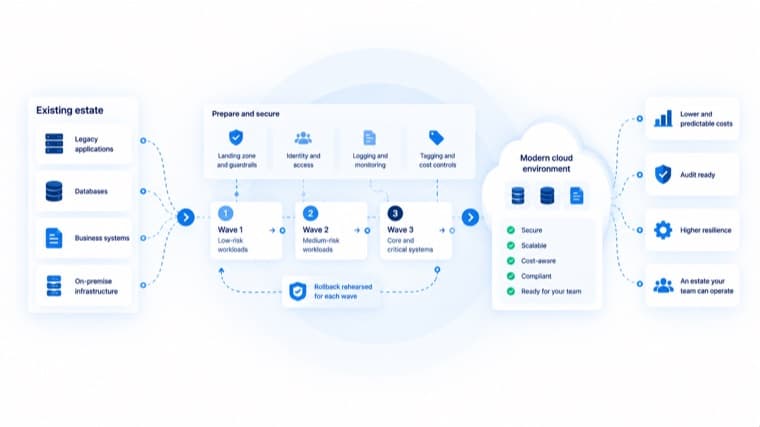
We do the assessment and landing-zone work before anything moves, migrate in rehearsed waves with a defined rollback, and hand over an operating model your own engineers can run without us.

  • Every environment reproducible from code, including production
  • Cost attributed to teams and features and reviewed monthly
  • Recovery objectives demonstrated by rehearsal, not asserted
  • Security guardrails enforced by policy rather than convention
  • An operating runbook your engineers own by the end

Typical engagement

Starts with: a short, fixed-scope discovery

First release: in production early, not at the end

Team: named in the proposal

Exit: documented and rehearsed from day one

Discuss this service

Capabilities

What this practice covers

Cloud migration

Assessment, wave planning and execution across rehost, replatform and refactor paths, with rollback defined for every wave.

Cloud-native architecture

Containers, managed services and serverless designed around your actual traffic profile and failure tolerance.

Landing zones & governance

Account structure, network design, identity, tagging and policy guardrails codified from day one.

Cost optimisation

Spend attribution, rightsizing, commitment planning and unit-economics reporting the finance team can use.

Resilience engineering

Multi-AZ and multi-region design, with backup and restore rehearsed rather than assumed.

Managed cloud operations

Monitoring, patching, incident response and capacity planning under an agreed service level.

How we deliver

From first conversation to a running system

Step 01

Assess

Discovery of the estate: dependencies, licensing, data gravity, compliance constraints and a migration scorecard per workload.

Step 02

Design the landing zone

Accounts, networking, identity, logging and policy as code, established before the first workload moves.

Step 03

Migrate in waves

Low-risk workloads first to prove the runbook, then progressively harder ones with measured cutover windows.

Step 04

Optimise & operate

Post-migration tuning, cost review cycles and an operating model your team owns.

Technology

What we build with

We keep a deliberately narrow toolset so the depth is real. Within it, the choice is made per engagement based on your team and your constraints rather than our preferences.

Where your team already knows a technology well, that usually outweighs a marginal technical advantage elsewhere — and we will say so.

AreaTools and platforms
PlatformsAWS, Microsoft Azure, Google Cloud, Oracle Cloud Infrastructure
OrchestrationKubernetes, EKS, AKS, GKE, ECS, Docker
Infrastructure as codeTerraform, CloudFormation, Bicep, Ansible
OperationsGrafana, Prometheus, CloudWatch, OpenTelemetry

Questions

Cloud Solutions, answered plainly

The questions clients actually ask about this practice, including the awkward ones.

All FAQs

No. Our architects work across AWS, Azure, Google Cloud and Oracle Cloud Infrastructure. Where a client has no existing commitment we recommend based on workload fit, data residency and the skills already in the team — and where an organisation already runs Oracle Database or Oracle applications, the licensing case for OCI is often decisive.

A single application is typically a matter of weeks including hardening. A full estate runs in waves over months, with business value landing from the first wave rather than at the end.

Usually a substantial part of it. Rightsizing, storage tiering, commitment coverage and removing orphaned resources recover meaningful spend early. Deeper savings need architectural change, which we cost separately.

Yes, as a managed service with defined response and resolution targets, or as a co-managed model where we cover out-of-hours and your team runs business hours.

Start a conversation

Tell us what is not working. We will tell you what we would do about it.

An hour with our team, no charge and no obligation. You will leave with a point of view on the problem whether or not you work with us.

Monday to Saturday, 10:00 – 19:00 IST