Customer portals and self-service booking
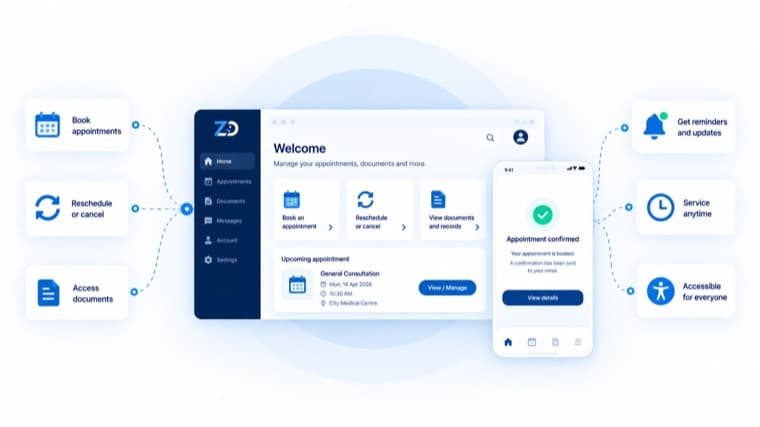
Self-service that genuinely reduces inbound contact, designed around the moments that decide whether someone completes the task or picks up the phone.
UI/UX Design
Interface work grounded in research and validated with real users. We design products people complete tasks in, then measure against the baseline we captured before the work started.
Overview
A research-led design practice working most often on complex operational products — the systems people use all day — rather than marketing pages. Every state gets designed, including the ones prototypes usually skip.
Typical engagement
Starts with: a short, fixed-scope discovery
First release: in production early, not at the end
Team: named in the proposal
Exit: documented and rehearsed from day one
Capabilities
Stakeholder alignment, user interviews, journey mapping and a prioritised opportunity backlog.
Task flows, information architecture, wireframes and interactive prototypes tested with real users.
Production-ready visual design across breakpoints, states, empty cases and error paths.
Tokenised libraries in Figma mirrored in code, with governance so the system survives delivery pressure.
Moderated and unmoderated studies with findings written as engineering tickets, not as a slide deck.
WCAG 2.2 audits, remediation design and validation with screen readers and keyboard-only navigation.
How we deliver
Step 01
Interviews with users and the people who support them, plus analytics and the support queue — which is where a product's real problems are recorded.
Step 02
We agree the problems worth solving and the measure each one moves before proposing an interface.
Step 03
Prototypes tested with a handful of participants per round, iterating until task success holds steady.
Step 04
Design QA against the build, then measurement against the baseline captured at the start.
Technology
We keep a deliberately narrow toolset so the depth is real. Within it, the choice is made per engagement based on your team and your constraints rather than our preferences.
Where your team already knows a technology well, that usually outweighs a marginal technical advantage elsewhere — and we will say so.
| Area | Tools and platforms |
|---|---|
| Design | Figma, FigJam, Framer |
| Research | Maze, Dovetail, Hotjar |
| Handoff | Storybook, Zeroheight, W3C design tokens |
| Validation | axe DevTools, VoiceOver, NVDA |
Where this applies

Self-service that genuinely reduces inbound contact, designed around the moments that decide whether someone completes the task or picks up the phone.

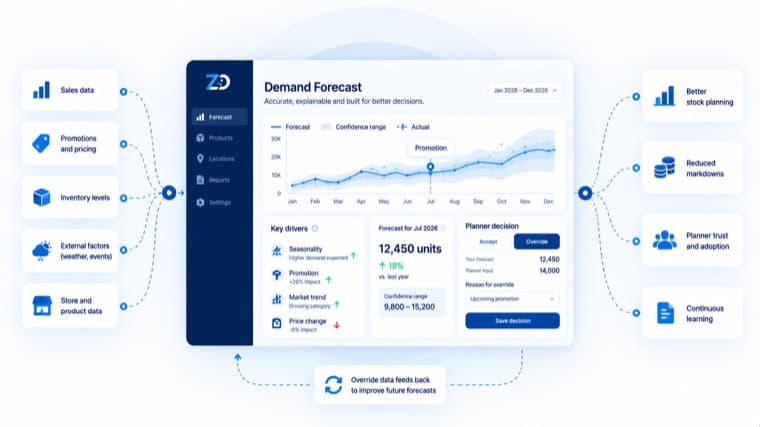
Forecasts that planners actually use, because the system explains itself, shows its uncertainty and records the reasons for overrides.
Questions
The questions clients actually ask about this practice, including the awkward ones.
Yes. A good share of our design work is delivered to a client's own engineering team, and we include implementation support and design QA so the built product matches the intent.
Five to eight per round for qualitative studies, repeated across rounds — that surfaces the large majority of usability problems. Benchmarking and preference testing need larger unmoderated samples.
Often. We audit what exists, extend it where there are gaps, and document additions in your conventions rather than importing ours.
An audit against WCAG 2.2 AA, a remediation plan ranked by user impact, design fixes, and validation with screen readers and keyboard-only navigation, ending in a conformance statement.
Related practices
Most work combines two or three practices under a single delivery lead.
Corporate sites, portals and web applications.
Explore service02Drupal builds, modules, migrations and support.
Explore service03Native and cross-platform apps for iOS and Android.
Explore service04Custom platforms, integrations and product engineering.
Explore service05Migration, cloud-native architecture and cost control.
Explore service06Applied AI, LLM systems and decision intelligence.
Explore serviceStart a conversation
An hour with our team, no charge and no obligation. You will leave with a point of view on the problem whether or not you work with us.
Monday to Saturday, 10:00 – 19:00 IST