Solution

Offline-first field and inspection applications

Applications for people working where connectivity cannot be assumed — designed so being offline is the normal case rather than a degraded one.

UtilitiesConstructionField services
6
Core capabilities
3
Practices involved
Architecture
Explained openly
Offline-first field and inspection applications

The business challenge

Field applications are specified in meeting rooms with reliable wifi and used in basements, culverts, loading bays and rural sites. An application that stalls at the point of use is worse than the paper form it replaced.

The difficult case is not the absence of a connection, which is easy to detect. It is a connection that resolves, opens a socket and then delivers a fraction of the packets, where naive implementations hang, retry, duplicate and eventually corrupt.

Where the data feeds regulatory reporting, the gap between inspection and record becomes a compliance exposure as well as an efficiency problem.

Our solution

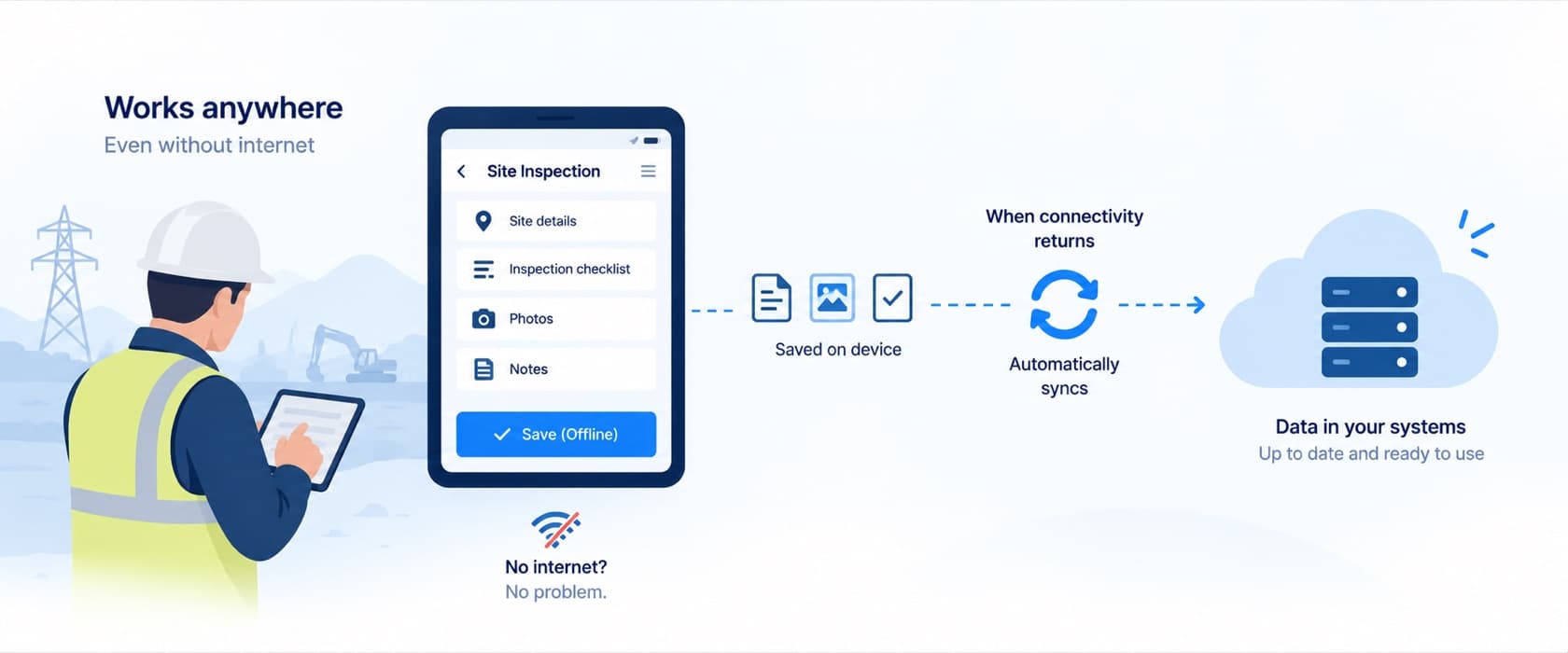
Offline is treated as the default operating state. Every feature is specified twice, once connected and once disconnected, and the disconnected specification governs.

Before test design starts, our engineers spend time with the people who will use the product. That produces the conditions the test suite is built around: gloved hands, direct sunlight, low battery, a dropped device and a sync interrupted mid-flight.

Every write operation is classified with you as safe offline, safe with reservation, or requiring connectivity. The third category is legitimate and under-used — some operations should be blocked, and saying so clearly beats a conflict flow nobody understands.

Capabilities

Key features and capabilities

Local-first data layer

Work completes on the device; the interface never blocks on the network.

Deterministic sync

Idempotent writes with client-generated identifiers and an ordered, dependency-aware queue.

Human conflict resolution

Both versions preserved with provenance and a person decides, rather than silent overwrites.

Honest sync status

Explicit state — queued, sent, failed — instead of an ambiguous spinner.

Schema-driven forms

Your standards team changes inspection forms without a release cycle.

Field-condition testing

Physical device coverage plus simulated packet loss, latency and interruption.

  • Inspections recorded once, at the point of work, rather than transcribed later.
  • No lost work when connectivity fails mid-task.
  • Media and evidence captured against the record automatically.
  • Reporting lag reduced from days to the next connection.
  • Field trust in the data, which is what determines whether the system is used.

Outcomes

Benefits

What this changes for the organisation once it is running. These are the outcomes the design targets, agreed with you as measures before build starts.

Technology

Relevant technologies

Indicative rather than fixed. The specific choices follow your existing estate, your team's skills and the constraints we find during discovery, and are recorded as architecture decisions before build.

AreaTypical choices
MobileFlutter or React Native, or fully native where device integration demands
Local storageSQLite or Realm with a purpose-built sync layer
Sync serviceConflict detection with vector clocks and provenance
TestingPhysical device lab plus network-condition simulation

Start a conversation

Tell us what is not working. We will tell you what we would do about it.

An hour with our team, no charge and no obligation. You will leave with a point of view on the problem whether or not you work with us.

Monday to Saturday, 10:00 – 19:00 IST