Solution

Document processing and workflow automation

Extracting structured data from messy real-world documents, with confidence thresholds tuned to the cost of being wrong and people kept on judgement.

InsuranceFinanceLegalPublic sector
6
Core capabilities
3
Practices involved
Architecture
Explained openly
Document processing and workflow automation

The business challenge

Back-office processes often receive between a handful and many dozens of documents per case: reports, invoices, photographs, correspondence and schedules. All of it is read by a person and keyed into a system.

Commercial extraction products typically perform well on clean templates and poorly on the photographed, handwritten and scanned material that makes up most real intake — which is exactly the part consuming the time.

The consequence is a process where most of the elapsed time is administration rather than assessment, and where customer satisfaction tracks handling time almost exactly.

Our solution

We begin with a time-boxed proof of value on a stratified sample of your real documents, deliberately weighted towards the difficult end, with a field-level accuracy target agreed in advance.

The evaluation harness is built before the pipeline. Every subsequent change — model version, prompt, rule, threshold — is measured against an annotated set, and results are visible to the operational team rather than only to engineering.

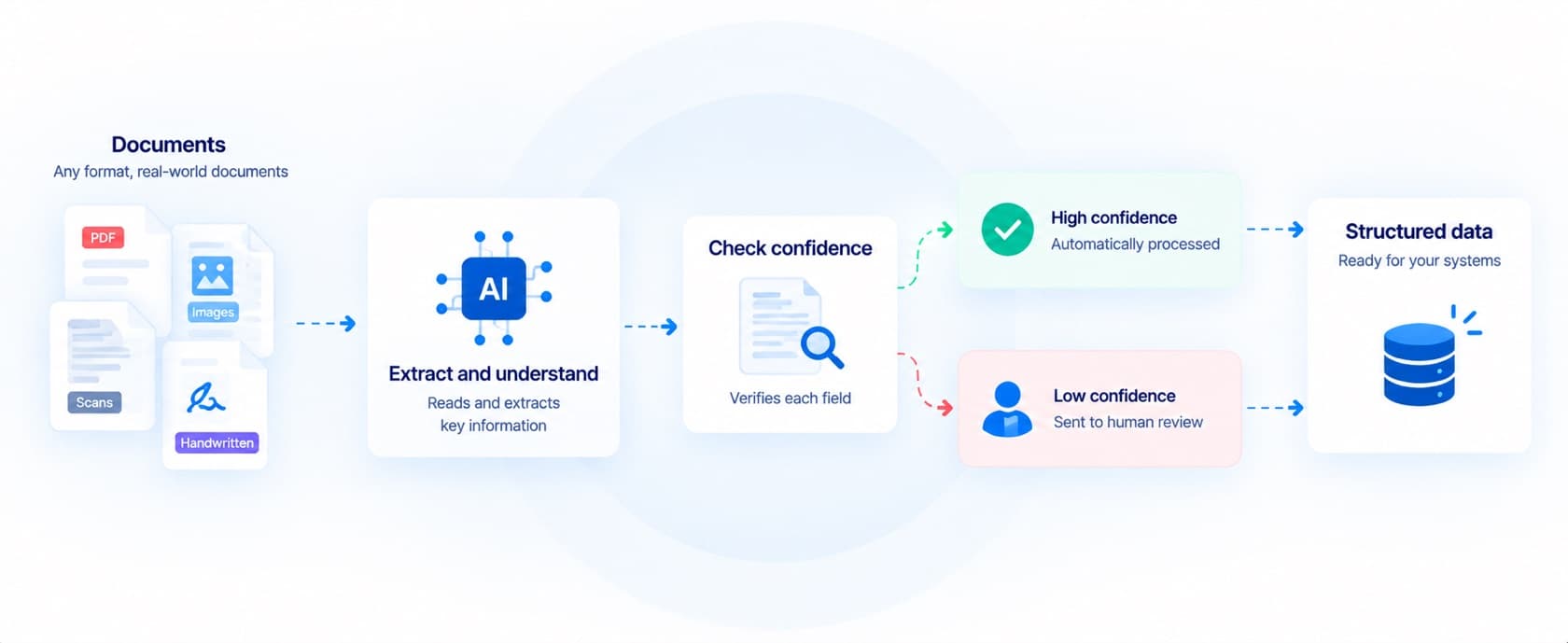
Confidence thresholds are then tuned per field according to the cost of being wrong, because a reference lookup and a payment instruction do not warrant the same threshold. That single decision determines both the automation rate and the risk profile.

Capabilities

Key features and capabilities

Confidence-gated automation

Per-field thresholds decide what is written automatically and what is reviewed.

Source-region citation

Every extracted value traceable to the part of the document it came from.

Review workspace

Value shown beside its source, correctable in one action, designed for throughput.

Business-rule validation

Extractions checked against systems of record before anything is written.

Corrections as training data

Every human correction captured, growing the evaluation set over time.

Quality reporting

Accuracy by document type and field, reported to the operational team.

  • Handling time reduced, with effort concentrated on assessment rather than administration.
  • A measurable straight-through processing rate that can be tuned deliberately.
  • An audit trail linking every automated value to its source.
  • Staff redeployed to judgement work rather than data entry.
  • Accuracy that improves over time rather than degrading.

Outcomes

Benefits

What this changes for the organisation once it is running. These are the outcomes the design targets, agreed with you as measures before build starts.

Technology

Relevant technologies

Indicative rather than fixed. The specific choices follow your existing estate, your team's skills and the constraints we find during discovery, and are recorded as architecture decisions before build.

AreaTypical choices
ExtractionCloud document-understanding services or self-hosted models
Language modelsHosted enterprise endpoints, or open weights where residency requires
PipelineQueue-based processing with structured output validation
ReviewPurpose-built workspace integrated with the case management system

Start a conversation

Tell us what is not working. We will tell you what we would do about it.

An hour with our team, no charge and no obligation. You will leave with a point of view on the problem whether or not you work with us.

Monday to Saturday, 10:00 – 19:00 IST