
Retrieval-augmented generation: architecture that holds up in production
A working retrieval pipeline is straightforward. Making it reliable enough to trust with business questions is where the engineering is.
ZooBieDoo Infotech Engineering TeamRead
Governance is largely about being able to explain what a system does, on what data, with what oversight, and to evidence it.
The first governance failure is not knowing which AI systems exist. Shadow deployments — a team wiring a model into a process without review — are common and are what regulators and auditors find.
Maintain an inventory: purpose, data used, model, who owns it, what decisions it influences and what oversight exists.
Written at the time, this is a modest document. Reconstructed a year later under audit pressure, it is a project.
Human oversight is often described as a safeguard and implemented as a rubber stamp. If a reviewer sees hundreds of items and approves nearly all, the oversight is not real.
Design it so the human sees the evidence, has time to assess, and can disagree without friction. Route only genuinely uncertain cases to review so attention is not diluted.
Data drifts, usage changes, and behaviour that was acceptable at launch may not remain so. Sample outputs for quality on an ongoing basis and track the rate of human overrides — a rising override rate is an early warning.
Set a review cadence per system proportional to its risk, and record that the review happened.
Where an AI system influences decisions affecting people, being able to explain a specific outcome matters both to regulators and to the person affected.
Retain the inputs, the model version, the retrieved context and the output for each consequential decision, for a period proportionate to the risk. Reconstructing why a system produced a particular answer months later is otherwise impossible.
This is a design decision with storage and privacy implications, which is why it belongs in the initial architecture rather than being added when the first challenge arrives.
Yes. Governance concerns how you use the system and what decisions it influences, regardless of who trained the model.
Use enterprise endpoints with training opt-out and retention terms, or self-host open-weight models where policy requires it. Record which applies to each system.
It works best shared: a business owner accountable for outcomes and a technical owner accountable for behaviour. Placing it solely with either produces gaps.
Keep reading
A working retrieval pipeline is straightforward. Making it reliable enough to trust with business questions is where the engineering is.
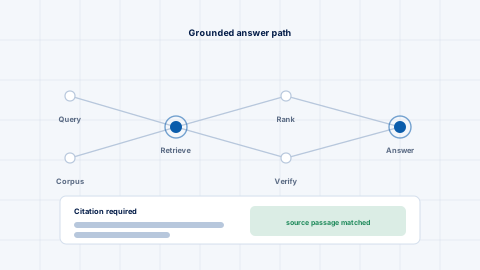
Connecting a language model to your documents is the straightforward part. The reliability work is everything after that, and it looks nothing like the demonstration.
Without an evaluation set, every change to a language model system is argued on anecdote. Building one is the highest-value early task.