
Retrieval-augmented generation: architecture that holds up in production
A working retrieval pipeline is straightforward. Making it reliable enough to trust with business questions is where the engineering is.
ZooBieDoo Infotech Engineering TeamRead
Topic
Every article we have published on ai & data.
A working retrieval pipeline is straightforward. Making it reliable enough to trust with business questions is where the engineering is.
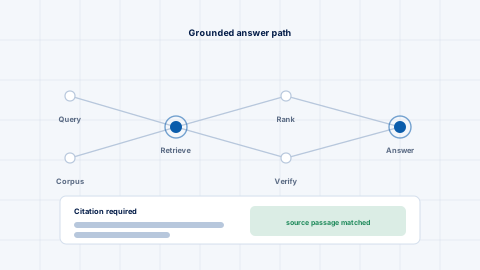
Connecting a language model to your documents is the straightforward part. The reliability work is everything after that, and it looks nothing like the demonstration.
Without an evaluation set, every change to a language model system is argued on anecdote. Building one is the highest-value early task.
Governance is largely about being able to explain what a system does, on what data, with what oversight, and to evidence it.
Extracting structured data from real-world documents is achievable. The engineering is in confidence thresholds and review design.
Most models that fail in production fail operationally rather than statistically. Reproducibility, deployment and monitoring are the gap.
Forecasting adds value when planners act on it. That depends more on explaining uncertainty than on squeezing out accuracy.
Most failed AI projects were poor candidates before any code was written. A short triage saves considerable money.
Prompts in production are code: versioned, tested and monitored. Treating them as configuration edited in place causes silent regressions.
Model choice rarely limits an AI project. Data availability, labelling and consistency almost always do.
Inference costs scale with usage in ways that surprise teams. A few architectural decisions control most of the bill.
Vision projects succeed or fail on lighting, positioning and consistency far more often than on model architecture.