
Retrieval-augmented generation: architecture that holds up in production
A working retrieval pipeline is straightforward. Making it reliable enough to trust with business questions is where the engineering is.
ZooBieDoo Infotech Engineering TeamRead
Most failed AI projects were poor candidates before any code was written. A short triage saves considerable money.
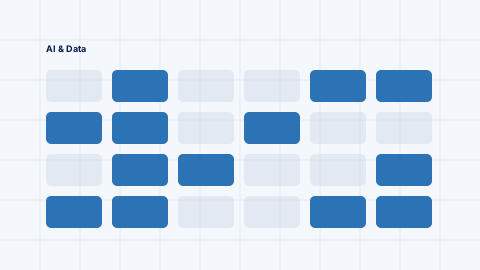
Value: what changes if this works, expressed in money or time rather than in adjectives. Feasibility: is the task one that current techniques do reliably. Data readiness: does the data exist, is it accessible, is it labelled or labellable.
A use case scoring poorly on any one of the three is not ready, however appealing the others look.
The best early candidates are high-volume, well-defined tasks where a modest improvement compounds and errors are recoverable. Classification, extraction, routing and summarisation of internal documents all fit.
The worst are broad, judgement-heavy tasks where errors are costly and the correct answer is contested even among experts.
Use cases where errors are invisible or irreversible need much higher accuracy and much stronger oversight, which changes the economics considerably.
Run a time-boxed proof of value on real data with success criteria agreed in advance and a genuine option to stop.
The criteria must be agreed before results appear. Deciding afterwards whether the outcome was good enough reliably produces a positive verdict, which is how projects proceed that should not have.
Organisations that succeed with AI usually run several small assessments rather than one large programme. Maintain a ranked list of candidate use cases, revisited as data and capability improve.
Record why each was deferred. Use cases blocked by data availability often become viable once an unrelated data project completes, and without a record nobody reconnects the two.
Deliver something small and useful early. Credibility earned on a modest working system funds the ambitious one far more reliably than a business case does.
Weeks rather than months. If it cannot be assessed in that time, the scope is too broad and should be narrowed.
That is a finding worth having early. Often a smaller, better-scoped problem is achievable now while data work proceeds for the larger one.
Buy where the capability is commoditised transcription, translation, general document extraction. Build where the value comes from your own data or process.
Keep reading
A working retrieval pipeline is straightforward. Making it reliable enough to trust with business questions is where the engineering is.
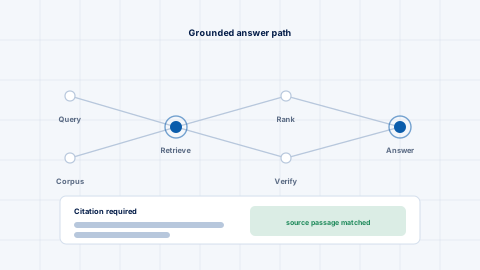
Connecting a language model to your documents is the straightforward part. The reliability work is everything after that, and it looks nothing like the demonstration.
Without an evaluation set, every change to a language model system is argued on anecdote. Building one is the highest-value early task.