
Retrieval-augmented generation: architecture that holds up in production
A working retrieval pipeline is straightforward. Making it reliable enough to trust with business questions is where the engineering is.
ZooBieDoo Infotech Engineering TeamRead
Model choice rarely limits an AI project. Data availability, labelling and consistency almost always do.
Sample the data and have someone who knows the domain grade it. Completeness, accuracy, consistency of definitions across systems, and how far back reliable history goes.
This assessment frequently changes the project. Discovering during a proof of value that a critical field has been optional for two years is far cheaper than discovering it later.
The same field often means different things in different systems, and the meaning changes over time as processes change. A status code that was repurposed three years ago will quietly corrupt any model trained across that boundary.
Document the meaning of each field, and when it changed. This is unglamorous work and it determines whether the results are trustworthy.
Cleaning an extract once produces a model that degrades as new data arrives with the same problems. Fix quality at the source or in the ingestion pipeline so improvements persist.
Add validation at ingestion that rejects or flags records failing basic expectations. Catching problems at entry is far cheaper than reconciling them later.
Data quality is treated as a preparation task and then stops being watched, which is when models degrade silently as upstream systems change.
Add automated checks on incoming data: expected value ranges, null rates, category cardinality and record volumes. Alert when they move beyond normal variation, because that is usually the earliest signal of a model problem.
These checks catch upstream changes — a renamed category, a changed unit, a broken integration — long before accuracy metrics reflect them.
It depends on the task. Retrieval and extraction can work with modest corpora; learning a subtle pattern from scratch needs considerably more. Quality and representativeness matter more than raw volume.
For augmenting rare cases and for testing, yes. As a substitute for real data it tends to encode the assumptions used to generate it.
The team that owns the source system, with support. Making it the modelling team's responsibility moves the fix far from the cause.
Keep reading
A working retrieval pipeline is straightforward. Making it reliable enough to trust with business questions is where the engineering is.
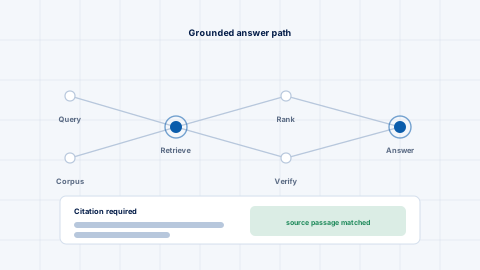
Connecting a language model to your documents is the straightforward part. The reliability work is everything after that, and it looks nothing like the demonstration.
Without an evaluation set, every change to a language model system is argued on anecdote. Building one is the highest-value early task.