
Retrieval-augmented generation: architecture that holds up in production
A working retrieval pipeline is straightforward. Making it reliable enough to trust with business questions is where the engineering is.
ZooBieDoo Infotech Engineering TeamRead
Extracting structured data from real-world documents is achievable. The engineering is in confidence thresholds and review design.
Commercial extraction tools perform well on consistent forms and poorly on the photographed, handwritten and scanned material that makes up most genuine intake — which is exactly the part consuming the time.
Assess against a stratified sample weighted towards the difficult end, not against the tidy examples.
The cost of being wrong differs by field. A reference number read incorrectly is an inconvenience; a payment amount read incorrectly is a serious problem.
Set thresholds per field according to that cost. Anything below routes to human review; anything above is written automatically. This single decision determines both the automation rate and the risk profile.
The review interface determines the throughput of the whole system, and it is routinely built last with the least attention.
Never write extracted values straight into a business system. Validate against what you already know: does the reference exist, does the amount fall within the policy limit, does the date make sense.
Business-rule validation catches a substantial share of extraction errors regardless of model quality, and it is cheap to implement.
Extraction accuracy is an engineering measure. The business measure is what proportion of documents complete without human involvement, and how much handling time fell.
Track straight-through processing rate, time per document end to end, and the rework rate where an automated extraction later proved wrong. These are what justify the investment and what reveal whether thresholds are set sensibly.
A system with high accuracy and low straight-through rate usually has thresholds set too conservatively, which is a tuning decision rather than a model problem.
It depends heavily on document quality and field type. Printed structured fields extract very reliably; handwriting and poor scans considerably less so. Measure on your own documents before committing to a target.
Often not initially. General document-understanding services plus business-rule validation handles many cases. Custom training is worth it for high volume in a narrow, stable format.
Confirm language coverage in your extraction service and evaluate separately per language. Accuracy commonly varies more between languages than teams expect.
Keep reading
A working retrieval pipeline is straightforward. Making it reliable enough to trust with business questions is where the engineering is.
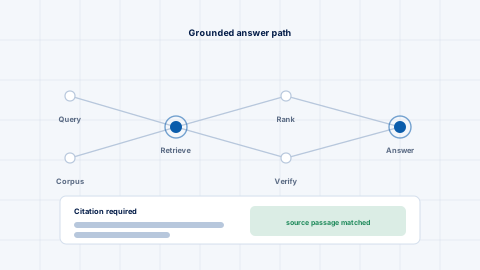
Connecting a language model to your documents is the straightforward part. The reliability work is everything after that, and it looks nothing like the demonstration.
Without an evaluation set, every change to a language model system is argued on anecdote. Building one is the highest-value early task.