
Upgrading from Drupal 10 to Drupal 11: what actually changes
Drupal 11 is a far smaller step than the Drupal 7 to 9 migration was. Here is what the upgrade touches, what breaks, and the order to do it in.
ZooBieDoo Infotech Engineering TeamRead
Topic
Every article we have published on drupal.
Drupal 11 is a far smaller step than the Drupal 7 to 9 migration was. Here is what the upgrade touches, what breaks, and the order to do it in.
Most difficult Drupal builds are content-modelling failures, not code failures. How to model entities, fields and taxonomies so a site stays maintainable.
Drupal has a strong security team and a predictable advisory process. The risk on most sites is not the platform, it is that nobody is watching the advisories.
Drupal handles translation better than most content platforms, but the decisions you make in the first week determine whether adding a language later is easy or painful.
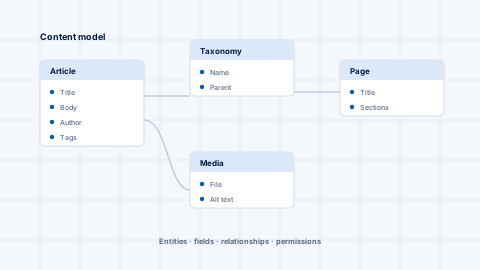
Both are mature and both are capable. The decision should follow how structured your content is, how complex your permissions are, and who has to maintain it in three years.
A slow Drupal site is usually slow for a small number of identifiable reasons. Measure before you cache, and cache at the right layer.
Custom modules are where Drupal projects accumulate their long-term cost. A few conventions keep them readable and upgradeable.
A Drupal theme is a long-lived asset. Template structure, naming and component boundaries determine how much of it survives the next visual refresh.
A platform migration is mostly a content mapping exercise and an SEO exercise. The code is the easy part.
Views is one of Drupal's strongest features and one of its easiest ways to build a slow page. A few habits keep listings fast.
Headless Drupal solves real problems and creates new ones. The decision should follow how many consumers the content genuinely has.
Drupal core has good accessibility foundations. Most failures on Drupal sites are introduced by the theme, the content or a contributed module.
The right e-commerce platform depends on how unusual your catalogue and checkout rules are, and how much of the operation is bespoke.
A content management system is a product used daily by a small group of people. Their experience is usually designed last, if at all.