
Retrieval-augmented generation: architecture that holds up in production
A working retrieval pipeline is straightforward. Making it reliable enough to trust with business questions is where the engineering is.
ZooBieDoo Infotech Engineering TeamRead
Vision projects succeed or fail on lighting, positioning and consistency far more often than on model architecture.
The single highest-return investment in an industrial vision project is usually consistent lighting and fixed camera positioning. Variable conditions force the model to solve a much harder problem than the one you care about.
Where conditions cannot be controlled — outdoor inspection, handheld capture — the training data must represent that variability honestly, which means considerably more of it.
Defect detection datasets are dominated by good examples. A model that predicts pass every time can appear highly accurate and be useless.
Full automation is rarely the right first step. Systems that flag for human confirmation deliver value sooner and build the labelled data needed to justify more automation later.
Design the operator interface properly — it determines throughput as much as the model does.
Factory and field deployments often cannot rely on connectivity or tolerate cloud latency. That constrains model size and requires a deliberate update mechanism for devices that are intermittently connected.
Decide early whether inference is on-device, on-premise or cloud, because it shapes the architecture and the model choices available.
A vision system that works in a trial frequently degrades in production for physical reasons: a camera drifts out of position, a lens gets dirty, lighting changes seasonally, or a supplier changes packaging.
Build monitoring for the input as well as the output — image brightness, sharpness and framing statistics reveal capture drift before accuracy visibly falls.
Plan for periodic recalibration and retraining, and make sure someone on site owns the physical setup. Vision projects fail in maintenance more often than in modelling.
Fewer than expected when conditions are controlled and transfer learning is used; considerably more when conditions vary. Defect variety matters more than total count.
General object detection handles common categories well. Domain-specific defects almost always need training on your own examples.
Sometimes usable. Resolution, frame rate and mounting stability are the constraints to check before assuming they will do.
Keep reading
A working retrieval pipeline is straightforward. Making it reliable enough to trust with business questions is where the engineering is.
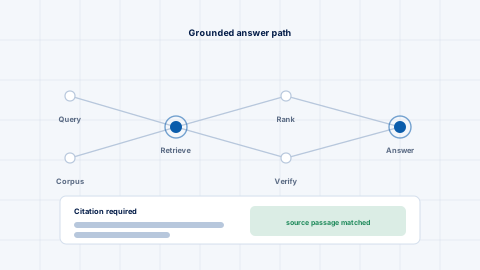
Connecting a language model to your documents is the straightforward part. The reliability work is everything after that, and it looks nothing like the demonstration.
Without an evaluation set, every change to a language model system is argued on anecdote. Building one is the highest-value early task.