The capabilities are more similar than the marketing suggests
Compute, storage, managed databases, networking, identity and the surrounding services exist in comparable form on all four of the major platforms. For the overwhelming majority of business workloads, any of them will do the job.
Differences that matter tend to be at the edges: specific managed services, regional availability, and how each platform's identity model fits your organisation.
What should actually decide it
- Existing commitments — an organisation already on Microsoft licensing and Active Directory has a genuine advantage on Azure.
- Data residency — check region availability for the specific services you need, not just the region list.
- Team skills — the platform your engineers already know will be operated better.
- Managed service fit — if one platform has a service that removes a large amount of work for your specific case, that is worth more than general parity.
- An existing Oracle estate — organisations already running Oracle Database or Oracle applications often find the licensing and performance case for Oracle Cloud Infrastructure hard to beat.
Multi-cloud is usually a cost, not a strategy
Running the same workload across two providers to avoid lock-in sounds prudent and is expensive. You get the lowest common denominator of both platforms, twice the operational surface, and two sets of skills to maintain.
The pragmatic version is portability rather than parallelism: use infrastructure as code, prefer open interfaces where the cost is low, and keep the migration path understood. That gives most of the benefit without the ongoing tax.
Where Oracle Cloud fits
Oracle Cloud Infrastructure is frequently left out of comparisons, and for organisations with no Oracle footprint that is often reasonable. Where an Oracle estate already exists, it changes the arithmetic considerably.
The strongest case is running Oracle’s own software. Licensing terms for Oracle Database are more favourable on OCI than on other providers, and managed Autonomous Database and Exadata services remove administration that would otherwise be yours to carry. For an organisation running Oracle Database, E-Business Suite or Fusion applications, that combination is difficult for the other platforms to match on cost alone.
Outside that, OCI competes on a few specific things: predictable and comparatively inexpensive data egress, bare-metal instances without a hypervisor, and straightforward pricing that does not vary by region as much. Against that, its catalogue of third-party managed services and its regional footprint are narrower than the other three, which matters if you depend on a particular service being available where you operate.
A pattern worth naming: OCI for the Oracle-dependent part of the estate, another provider for everything else. That is not the multi-cloud arrangement warned about above, because each workload lives in one place and the boundary is deliberate rather than accidental. It costs a second set of skills, and where the licensing saving is large it is straightforwardly worth it.
Pricing is not the differentiator people expect
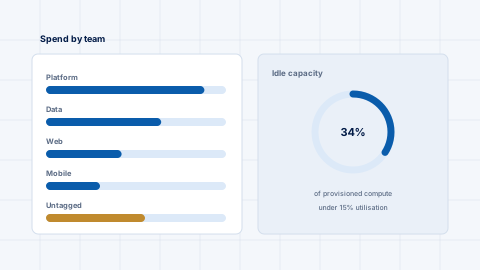
Published rates are broadly comparable and change often. What actually drives cost is architecture: how much you over-provision, whether you use committed-use discounts, how much data crosses regions, and whether idle environments run overnight.
A well-architected estate on the more expensive platform will comfortably beat a poorly architected one on the cheaper platform. Optimise the architecture before optimising the vendor.
Making the decision defensible
Because the platforms are broadly comparable, the decision is frequently made on preference and then justified afterwards. That is fine until someone asks why, usually during a cost review or an incident.
Write a short decision record: the criteria weighted, how each platform scored, and what would change the answer. It takes an hour and it prevents the choice being relitigated every time something goes wrong.
It also makes the next decision easier. Teams that record architectural choices build a body of reasoning that new people can read rather than reconstruct.