Cloud

A cloud cost optimisation checklist that does not require re-architecting

A meaningful share of cloud spend on a typical estate is recoverable without changing the architecture at all. Start there.

Key takeaways

  • Attribution comes first — enforce tagging before optimising.
  • Idle compute, orphaned resources and wrong storage tiers are the usual waste.
  • Rightsize before committing, or you lock in the waste.
  • A monthly engineer-attended review stops costs creeping back.

Find out where the money goes

You cannot reduce what you cannot attribute. Before anything else, enforce a tagging policy so every resource carries an owner, an environment and a cost centre, and make untagged resources fail to create.

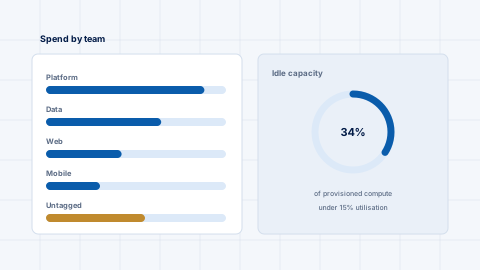
Then produce a breakdown by team and by service. The first run of this report is usually uncomfortable and always informative.

The recoverable waste

  • Idle and oversized compute — instances running well below capacity, sized years ago.
  • Non-production environments running overnight and at weekends — often two-thirds of their hours are unused.
  • Orphaned resources — unattached volumes, old snapshots, idle load balancers, unused elastic addresses.
  • Storage in the wrong tier — archival data sitting on hot storage.
  • Log and backup retention set to defaults nobody chose.

None of these require architectural change, and together they usually account for a substantial reduction.

Commitment coverage

Once the baseline is genuinely steady, committed-use discounts and reserved capacity offer meaningful savings for workloads that will certainly keep running. The mistake is committing before rightsizing, which locks in the waste.

Rightsize first, observe for a period, then commit to the reduced baseline.

Make it a routine

One-off optimisation exercises decay. Costs creep back as new resources appear without tags, environments get cloned and forgotten, and retention settings default.

A short monthly review, attended by engineers rather than only finance, keeps the estate honest. Showing teams their own spend changes behaviour more reliably than any policy document.

Cost as an architectural property

Beyond cleanup, the durable savings come from architecture. Autoscaling that actually scales down, storage lifecycle rules that move data to cheaper tiers automatically, and serverless components for spiky workloads all reduce cost without ongoing effort.

Data transfer is the charge most often overlooked. Traffic between regions and out to the internet accumulates quietly, and architectures that move data unnecessarily can cost more in transfer than in compute.

Design decisions made with cost in view are far cheaper than optimisation applied afterwards, which is why engineers seeing spend data changes outcomes more than any policy.


Frequently asked questions

It varies with how long the estate has been running unmanaged. Estates that have never had cost attribution usually find a significant proportion recoverable within a quarter through rightsizing and cleanup alone.

Native cost tooling is adequate for most organisations. Dedicated platforms add value at larger scale or across multiple providers, but they do not replace the tagging discipline that makes any of it useful.

Yes. Engineers make cost decisions constantly, and they make better ones when the consequences are visible. Hiding spend in a finance report guarantees it stays unmanaged.

Working on this?

A conversation with our team, no charge and no obligation.

Book a conversation