
Running agile delivery inside a fixed budget
Fixed budgets and iterative delivery are compatible if scope is the variable. Fixing all three is what causes trouble.
ZooBieDoo Infotech Engineering TeamRead
A fixed price on genuinely novel work is a negotiation about who absorbs uncertainty. There is a more honest structure, and clients increasingly prefer it.
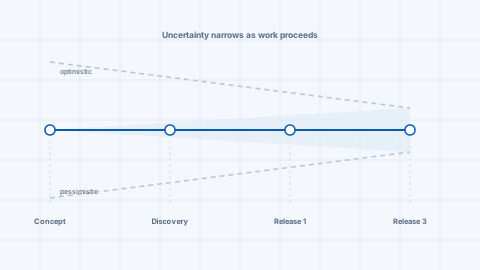
A client asks what a platform will cost. The honest answer at that moment is a range spanning a factor of several. The commercially convenient answer is a single number, and the industry has largely settled on the convenient one — then built an apparatus of change control and variation orders to manage the consequences.
The single number does not reduce risk. It relocates it, usually onto whichever party is less able to argue.
Uncertainty narrows predictably as work proceeds. At concept, a wide band either way is normal. After discovery it narrows considerably. Once the first increments are in production, a tight band becomes achievable and tends to hold.
So estimate in the shape the uncertainty actually has:
The most reliable predictor of estimate accuracy is not technique but granularity. Estimates built from items of a few days are consistently better than estimates built from items of a few weeks, because a multi-week item is where unknowns hide.
The decomposition is also diagnostic. If a feature cannot be broken into small pieces, it is not understood well enough to estimate — and that is worth knowing before it is worth costing.
Overruns cluster in the same places, and none of them is the feature work:
The most valuable output of a good estimation process is occasionally the recommendation not to proceed — which is only credible from a supplier willing to say it.
Keep reading

Fixed budgets and iterative delivery are compatible if scope is the variable. Fixing all three is what causes trouble.
People describe solutions rather than problems. Getting to the underlying need is most of the analyst's job.
Demonstrations show the path the vendor has rehearsed. A structured evaluation shows how the product handles your awkward cases.