
Running agile delivery inside a fixed budget
Fixed budgets and iterative delivery are compatible if scope is the variable. Fixing all three is what causes trouble.
ZooBieDoo Infotech Engineering TeamRead
Demonstrations show the path the vendor has rehearsed. A structured evaluation shows how the product handles your awkward cases.

Write and weight your criteria before seeing any product. Doing it afterwards means the criteria are shaped by what you have already been impressed by.
Separate must-have from desirable honestly. Long must-have lists usually contain preferences, and they eliminate good options for no real reason.
Provide your two or three most awkward scenarios and ask each vendor to show them. The standard demonstration is always the one that works well.
Ask for references in a similar sector and at a similar size, and ask them specific questions: what took longer than expected, what would you do differently, how responsive is support when something is genuinely broken.
Ask what they wish they had known. Reference customers are usually candid when asked precisely rather than generally.
Licence or subscription, implementation, integration, training, and the internal effort to run it. A cheaper licence with expensive integration is not cheaper.
Then ask how you would leave: can you export your data in a usable, documented format? Establishing that before signing is straightforward; establishing it afterwards is not.
Evaluations drift towards whoever presented most impressively rather than whoever scored best, and a little structure prevents that.
Score independently before discussing, so the room does not converge on the first strong opinion. Record the reasoning behind each score, not just the number. Keep the weighting fixed once agreed rather than adjusting it after seeing results.
Where a strong preference emerges that the scoring does not support, that is worth examining honestly. Sometimes the criteria missed something real; sometimes it is simply the better demonstration.
Three to five is usually enough for a genuine comparison without exhausting the team. More than that and the evaluation becomes superficial.
For significant commitments, yes. A short paid pilot with your data reveals far more than any demonstration, and vendors confident in their product will agree to one.
Buy where the capability is commoditised and your requirements are ordinary. Build where the process is genuinely your competitive advantage.
Keep reading
Fixed budgets and iterative delivery are compatible if scope is the variable. Fixing all three is what causes trouble.
People describe solutions rather than problems. Getting to the underlying need is most of the analyst's job.
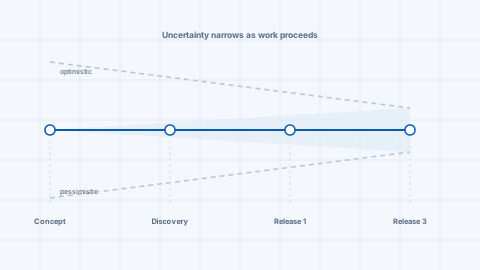
A fixed price on genuinely novel work is a negotiation about who absorbs uncertainty. There is a more honest structure, and clients increasingly prefer it.